Hartshorne loop hikes from Buttermilk (Navesink Road) are best hiked counter clockwise. Trails are poorly marked, and many unmapped access trails from nearby roads add to the fun of feeling lost. For a schematic, take an eight by eleven sheet of paper. Draw two parallel 6 inch horizontal lines, 2 or 3 inches apart. Connect them at the ends, and twice in the middle. Write fire road across the top horizontal. You now have 3 boxes, three loop hikes from Buttermilk parking at the top left, with the fire road at the top. I call them the 1-hour trail, the 1-1/2 trail, and the 2-hour trail. Below the third box, the one on the right, add a fourth box below it. You now have two loops for a 2-hour trail, a slightly longer middle loop (longer due to a more winding trail) and a lower loop. Above the fire road is the water tower. I rarely walk there, finding much less spiritual enrichment at the water tower and the multitude of access trails than I find in the loops below the fire road. To the right of your schematic are roads, one cinder-gravel leading down south, one blacktop leading up north to the Rocky Point loops (Portland Road access). The Rocky Point loops are much better mapped and self-explanatory. The Rocky Point blacktop loop, walked clockwise, has excellent views of the ocean and bay access. The woods trails in this loop are nice, too. If you really think you are missing something in the height of land around the water tower, stop by the Twin Lights lighthouse on the drive in to Rocky Point instead for a dramatic 240 degree view of the ocean, the City, and the bay.
Back to the Buttermilk loops on your schematic, they are best walked counter-clockwise immediately out of Buttermilk, because there are bay views close by and ocean views off in the distance when the leaves are down along the height of land about half-way into the 1-hour trail. Go to google maps, and your schematic four boxes will become confusing, but trust them. The fire road runs east west across the main ridge, with a very slight northwards arc easily visualized on google. The schematic 1-hour and 1-1/2 loops below the fire road are correct. They simply need to be morphed, pushed and pulled like elastic man around what shows on google (but not in the woods) as Tan Vat road. The 1-hour trail loop is pulled hard down and back up (to the 3-way intersection) then hard back down again. The 1-hour trail continues left, counter-clockwise at the 3-way intersection at the top left of Tan Vat on the google map. The 1-1/2 hour trail goes right at this 3 way-trail intersection and then turns hard left again down below just before the maintenance area. On the 2-hour trail, middle loop, when you run into the black top road on the right of the schematic, do not go left on the blacktop road. Go back about fifteen or thirty feet, continue up that dirt trail to the fire road, and the very mild height of land on the way is one of the finest moments in the park. If you go up the blacktop instead, you will still meet the end of the fire road on the left.
The Buttermilk section fire road has a very nice 150 year old unused carriage road ambiance to it, and now is a nice wide woods road. All counter clockwise loops from Buttermilk return along the fire road. The 1-1/2 hour trail and the 2-hour trail do not meet at a 4 way intersection incorrectly indicated on your schematic, but rather at two 3-way intersections. The lower loop 3-way intersection is below (before) the middle-loop 3-way intersection (walking counter-clockwise). Erase this 4 point intersection on your schematic. Move the junction of the lower loop a half-inch to the left to join in on the 1-1/2 hour trail, and your two 3-point intersections here now will be correct. Continue counter-clockwise at both of these 3-way intersections for the 1-1/2 hour trail. Pick up a map at the kiosk, and between that and your schematic, you should have a reasonably good understanding of the park.

 Get Directions
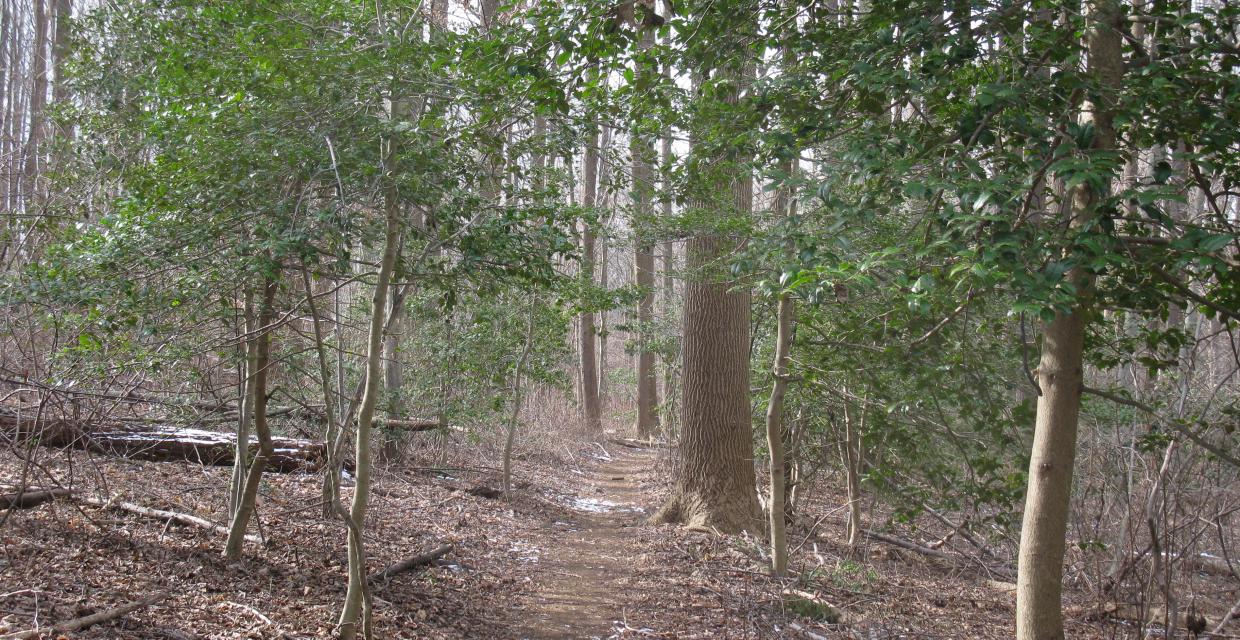
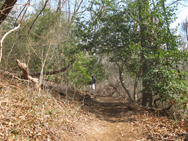 Trail. The trail now passes through thick stands of holly, with the trail tunneling under the holly at one point. It continues through an area with tangled vines. After curving to the right, the trail reaches a T-intersection where you should turn right (following the arrow). A short distance ahead, you'll reach another junction. Here, you should again turn right, following the sign to the "trailhead." The trail passes some more holly trees and tangled vines and soon reaches another junction marked with a signpost (this junction is not shown on the park map). Here, a side trail to the left leads out to Hartshorne Road, but you should turn right, following the sign to the "trailhead."
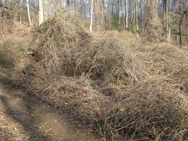 descending a little, the trail continues to ascend on a winding path to the crest of a hill, with limited seasonal views to the left over the Navesink River. The trail now begins to descend, passing a wooden cabin on the left. Just beyond, it reaches another intersection. This is the lowest point on the trail, 40 feet above sea level. Here, the trail turns right onto a woods road, passing houses on the left. Soon, the road narrows to a footpath and passes through mountain laurel thickets.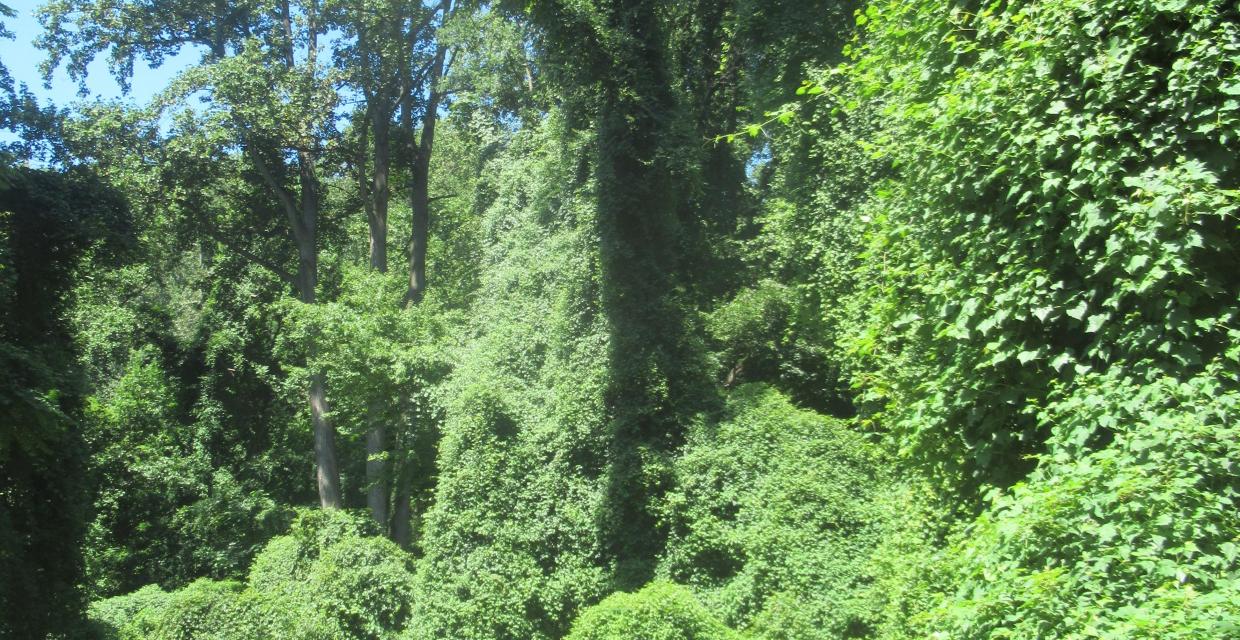

 Directions to Trailhead
 Public Transportation
 Support the trails with a donation!